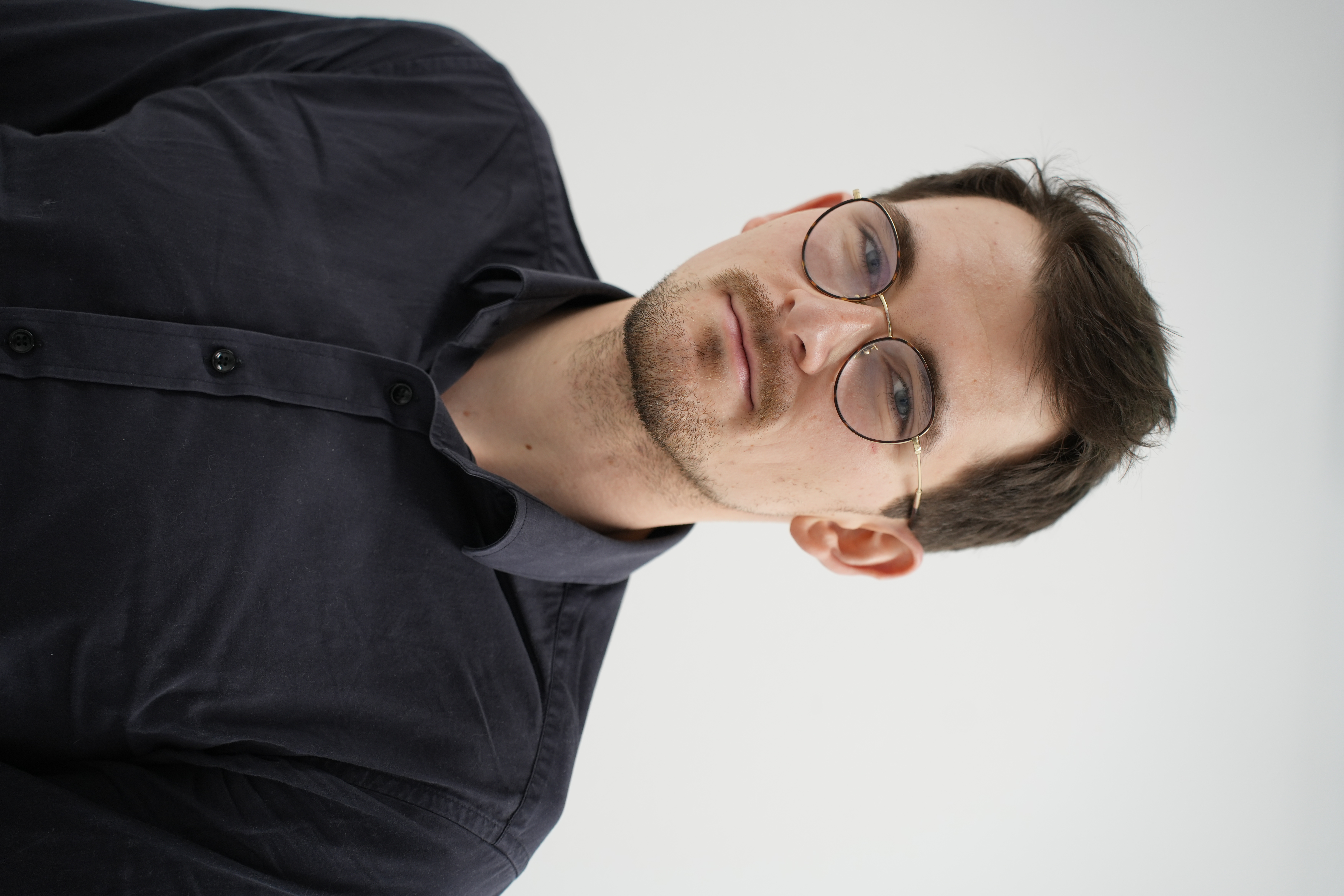
Kevin Maik Jablonka
We think AI has real scientific impact when it helps us develop new concepts and work with the data that actually matter to scientists.
I lead LAMALab at Friedrich Schiller University Jena. I want AI to do more than make predictions. Simply making more predictions can distract us from the scientific questions that matter. I believe its most important scientific use will be to deepen our understanding, help us develop new concepts, and give us recommendations we can act on. Building that path requires end-to-end learning and models whose conclusions we can understand and test. Our work has made oxidation states computable, revealed unexpected behaviour in an operating carbon-capture plant, and inferred molecular structures directly from raw spectra.
The Science of the Unaskable
Some questions remain out of reach because the concept, representation, or measurement they require does not yet exist. The task is to build that missing piece and carry it through to an experiment or decision. Build it on the measurement and the action rather than on an idealised structure, and the answer comes back actionable: that is how the unaskable turns into actionable understanding. The research programme sets out the path and the questions still open along it.
I want to know what a model has learned, which representation makes a conclusion possible, and where that conclusion fails. This connects to older questions about emergence and levels of description and about what we mean by molecular structure and shape.
Making this work requires chemistry, machine learning, psychometrics, and econometrics; I also work and teach with psychologists and social scientists. LAMALab created ChemPile, ChemBench, and MaCBench; through NFDI FAIRmat, we help make materials data machine-actionable. These resources let others inspect, test, and extend the work.
Science and people
I am in a privileged position, so I keep asking myself: How can I make the most significant contribution?
My two most important outputs are science and people; in fundamental research, people may matter even more. Science should change what we understand. People carry that understanding—and the tacit knowledge behind it—forward.
At LAMALab, scientific freedom rests on trust, kindness, and candour. We share unfinished ideas, data, code, and failures early. My role is to protect time for thought, ask hard questions, and help each researcher develop an independent direction. I want the lab to leave better questions, resources others build on, and people ready to lead.
Bios
The work reaches chemists, machine learning researchers, companies, funders, and students, and each of them needs a different account of it. Below are tailored biographies for those audiences; take whichever fits and edit freely.
Kevin Maik Jablonka is an Independent Research Group Leader at Friedrich Schiller University Jena, where he heads a Carl Zeiss Foundation research group and leads LAMALab. The group develops AI as a scientific instrument: making chemical concepts measurable and turning raw observations into the next experiment. His work has made oxidation states computable, inferred molecular structures directly from raw spectra, and revealed unexpected behaviour in an operating carbon-capture plant. He is a Google Research Scholar and Co-Speaker of NFDI FAIRmat.
Kevin Maik Jablonka is an Independent Research Group Leader at Friedrich Schiller University Jena, where he heads a Carl Zeiss Foundation research group and leads LAMALab. He is a member of the Center for Energy and Environmental Chemistry Jena and the Jena Center for Soft Matter, and is affiliated with HIPOLE Jena, the Michael Stifel Center, and the Acceleration Consortium in Toronto. LAMALab develops AI as a scientific instrument: making chemical concepts measurable and turning raw observations into the next experiment. The group combines chemistry and machine learning with psychometrics and econometrics to make measurement, uncertainty, and judgement explicit, and works with psychologists and social scientists to test where model and expert judgements agree and where they fail. His work has made oxidation states computable, inferred molecular structures directly from raw spectra, and revealed unexpected behaviour in an operating carbon-capture plant. LAMALab created ChemPile, ChemBench, and MaCBench as shared infrastructure others can inspect and extend.
Jablonka has received a Google Research Scholar Award, the Helmholtz AI Award for Best Digital Resource for ChemPile, and the Dimitris N. Chorafas Foundation Award for his EPFL doctoral thesis, and was elected to the Junge Akademie Mainz. He has been awarded more than €4M as principal investigator or project lead. He is Co-Speaker of NFDI FAIRmat, an Area Chair for NeurIPS 2026, a co-organiser of the 2027 Faraday Discussion on Digital Chemical Discovery, and the initiator of the first global chemical-sciences LLM hackathon. Recent work has appeared in Nature Chemistry, Nature Computational Science, Nature Communications, Science Advances, and the NeurIPS main proceedings.
Kevin Maik Jablonka leads LAMALab at Friedrich Schiller University Jena, where his group builds AI systems that return decisions chemists and engineers can act on rather than predictions they cannot check. His work has inferred molecular structures directly from raw spectra, made oxidation states computable, and revealed unexpected behaviour in an operating carbon-capture plant.
He leads a work package in the CARE-O-SENE consortium and its awarded follow-up, and runs the Intel–Merck MatAssist project. LAMALab’s evaluation suites, ChemBench and MaCBench, test whether chemical and multimodal models are fit for the tasks companies want to deploy them for; its ChemPile corpus received the Helmholtz AI Award for Best Digital Resource. Jablonka has received a Google Research Scholar Award and an NVIDIA Academic Grant, and advises on where these systems help and where they do not.
Kevin Maik Jablonka is an Independent Research Group Leader at Friedrich Schiller University Jena and Co-Speaker of NFDI FAIRmat, the German national research-data infrastructure consortium for materials science, where he works to make materials data machine-actionable. His research asks what a model has actually learned, which representation makes a conclusion possible, and where that conclusion fails: the questions that decide whether AI results in the sciences can be trusted and built upon.
LAMALab turns that work into public infrastructure. ChemPile, ChemBench, and MaCBench are open datasets and evaluation suites that let anyone inspect, test, and extend the claims made for chemical AI; ChemPile received the Helmholtz AI Award for Best Digital Resource. Jablonka reviews grants for the ERC, DFG, FWF, NWO, A*STAR and ScaDS.AI, represents HZB/HIPOLE in Helmholtz programme-oriented funding evaluations, and teaches a course on the critical aspects of AI jointly with sociologists. He has been awarded more than €4M as principal investigator or project lead, holds a Carl Zeiss Foundation research group, and is an elected member of the Junge Akademie Mainz.
Kevin Maik Jablonka leads LAMALab at Friedrich Schiller University Jena, a group of eleven doctoral researchers and a postdoctoral researcher working on AI for chemistry and materials science. He has supervised 26 appointments since 2021; alumni have gone on to graduate study in the United States and to research roles in industry.
At LAMALab, scientific freedom rests on trust, kindness, and candour: ideas, data, code, and failures are shared early, and his role is to protect time for thought, ask hard questions, and help each researcher develop an independent direction. In 2025 the group received the Best Research Environment award from Die Junge Akademie and the Volkswagen Foundation. Jablonka teaches a course on the critical aspects of AI jointly with sociology and a graduate seminar in cheminformatics, and publishes his teaching material openly. He did his PhD at EPFL, where his thesis received the Dimitris N. Chorafas Foundation Award, and is a member of the Helmholtz Leadership Academy.
Kevin Maik Jablonka is a chemist who leads an AI research group at Friedrich Schiller University Jena. He works on making artificial intelligence useful to science beyond prediction: his group has taught machines to read raw spectroscopic measurements and name the molecule that produced them, turned a textbook chemical concept into something a computer can calculate, and found unexpected behaviour in a working carbon-capture plant. He also builds the public tests, ChemBench and MaCBench, that show what today’s AI models can and cannot do in chemistry. He has received a Google Research Scholar Award and was elected to the Junge Akademie Mainz. He writes about AI and research practice at kjablonka.com.
Kevin Maik Jablonka leads LAMALab at Friedrich Schiller University Jena.
Recent work has appeared in Nature Chemistry, Nature Computational Science, Nature Communications, Science Advances, and the NeurIPS main proceedings; the full list says what each established. ORCID. 5,539 Google Scholar citations, h-index 27 (checked ). More than €4M in awarded funding as principal investigator or project lead.
Curriculum vitae
- —presentIndependent Research Group LeaderCarl Zeiss Foundation Research Group, Friedrich Schiller University Jena. Member of the Center for Energy and Environmental Chemistry Jena and the Jena Center for Soft Matter; affiliated with HIPOLE Jena, the Michael Stifel Center, and the Acceleration Consortium in Toronto. Co-Speaker of NFDI FAIRmat. Eleven doctoral researchers and one postdoctoral researcher; 26 appointments supervised since 2021, whose alumni have gone on to graduate study in the United States and to research roles in industry.
- —Independent contractor, AI evaluation and red teamingOpenAI.
- —PhD, Chemistry and Chemical EngineeringEPFL; Dimitris N. Chorafas Foundation Award and top-8% thesis distinction. Work from that period.
- —MSc, ChemistryEPFL; 5.95/6.00, second-highest GPA across all EPFL master’s graduates and highest in chemistry.
- —BSc, ChemistryTechnical University of Munich; high distinction.
More than €4M awarded as principal investigator or project lead: a Carl Zeiss Foundation research group (2023–2029), an Open Philanthropy project on agent benchmarks for spectroscopy, the Intel–Merck “MatAssist” project, and a Google Research Scholar Award.
Within consortia: local scientific lead for the Helmholtz Foundation Model Initiative project SOL-AI, principal investigator on two projects in the Carl Zeiss Foundation’s Nano@Liver programme, principal investigator and work-package leader in CARE-O-SENE and its awarded follow-up, and a project in the DFG Research Training Group COIN. Competitive compute from the Gauss Centre for Supercomputing and an NVIDIA Academic Grant.
Headline speaker at the Faraday Discussion on Emerging Materials for Optoelectronics in Edinburgh; the Nature Conference on AI for Sustainable Materials in Xi’an; the Frontiers of Solid State Theory symposium at the Max Planck Institute for Solid State Research; the Lennard-Jones Centre in Cambridge; the Machine Learning and Chemistry seminar at Caltech; CECAM’s AIChemist flagship workshop in Lausanne.
Keynotes at Machine Learning Physique Chimie in Lyon and at the Federation of European Zeolite Associations; a plenary at the first LLM for Materials hackathon at Imperial College London; and a panel with the President of the Helmholtz Association at Helmholtz Tech & Industry Day.
Critical Aspects of AI at Friedrich Schiller University Jena, taught jointly with sociology: chemists and social scientists read each other’s literature and argue about what these systems are doing to research practice. Alongside it, a graduate seminar on current topics in cheminformatics.
Previously: machine learning at the MolSim winter school in Amsterdam, and research data management, computational carpentry and the electronic lab notebook at EPFL.
Open material: matextract.pub, gpmbook.lamalab.org, interactive spectroscopy tools, and the machine learning course. More on teaching and supervision.
- Co-Speaker of NFDI FAIRmat; co-leader of WG3 in the DAEMON COST Action.
- Area Chair for NeurIPS 2026; area chair for the AI4Mat workshops at NeurIPS 2024 and ICLR 2025.
- Co-organiser of the 2027 Faraday Discussion on Digital Chemical Discovery; guest editor for a special issue on LLMs in Digital Discovery.
- Initiator of the first global chemical-sciences LLM hackathon; organiser of CECAM’s L2M3 and MADICES workshops.
- Grant reviewer for the ERC, DFG, A*STAR, FWF, ScaDS.AI and NWO; journal reviewer for the Nature and Science families, PNAS and JACS.
- Represents HZB/HIPOLE in Helmholtz programme-oriented funding evaluations. Helmholtz Leadership Academy.
- — Elected member, Junge Akademie Mainz
- — Member, Foresight Institute Berlin; ICML Gold Reviewer
- — Google Research Scholar Award
- — Helmholtz AI Award for Best Digital Resource, for ChemPile
- — Best Research Environment, Die Junge Akademie and the Volkswagen Foundation
- — Finalist, Rising Star in Computational Materials Science
- — Dimitris N. Chorafas Foundation Award
- — CAS Future Leader
- — Alfred Werner scholarship, Swiss Chemical Society
- — Studienstiftung des deutschen Volkes
Before any of that, I feel privileged to have taken part in student science fairs — a silver medal at the International Conference of Young Scientists in 2013, third nationally at Jugend forscht in 2014 — under the guidance of the mentors at a student research centre.
Photos and source material
Headshots by Marina Romanova / HIPOLE Jena.